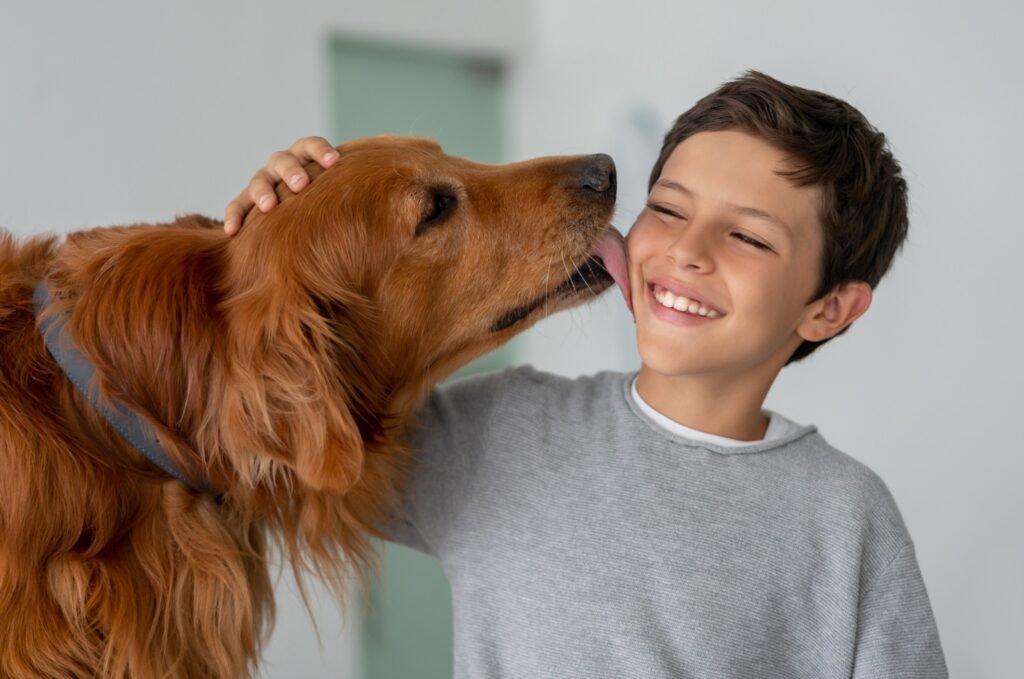
At first glance, many people interpret a dog’s licking as nothing more than affection. In many moments, there truly is an element of love and emotional bonding, but reducing this behavior to simply “love” oversimplifies something that can have several meanings at the same time. Your dog may lick your hand when you come home, your face when you get close, your feet while lying next to you, or even keep licking for several minutes without stopping. For many owners, this seems like just a cute gesture, but the truth is that licking is part of a much richer language than it first appears.
Dogs use physical contact as one of their main forms of social interaction. Unlike humans, who communicate heavily through speech, they communicate through body language, scent, touch, and proximity. Licking can represent affection, a search for attention, an attempt at sensory reading, and even a learned behavior that has been reinforced over time. In other words, your dog is not licking just because it “likes” you. Very often, it is trying to communicate something specific in that moment.
The most important thing is to understand the context in which it happens, because the same licking behavior can have different meanings depending on the situation.
It Can Be Affection and Social Bonding
One of the most common explanations is emotional bonding. Your dog associates you with its main source of safety, food, walks, playtime, and comfort. In this context, licking works as a form of closeness and social connection.
It is a behavior strongly linked to the group.
In your dog’s logic, staying close and interacting physically helps reinforce the bond.
In many cases, this truly is a sign of affection.
It Is Also Reading Your Scent
Another extremely important point is scent. Dogs use both smell and even taste to gather information about the environment and the people around them.
Sweat.
Skin scent.
Products used on the body.
Subtle chemical changes.
All of this can spark interest.
Sometimes it is not only showing affection.
It is investigating.
Your Reaction May Be Reinforcing It
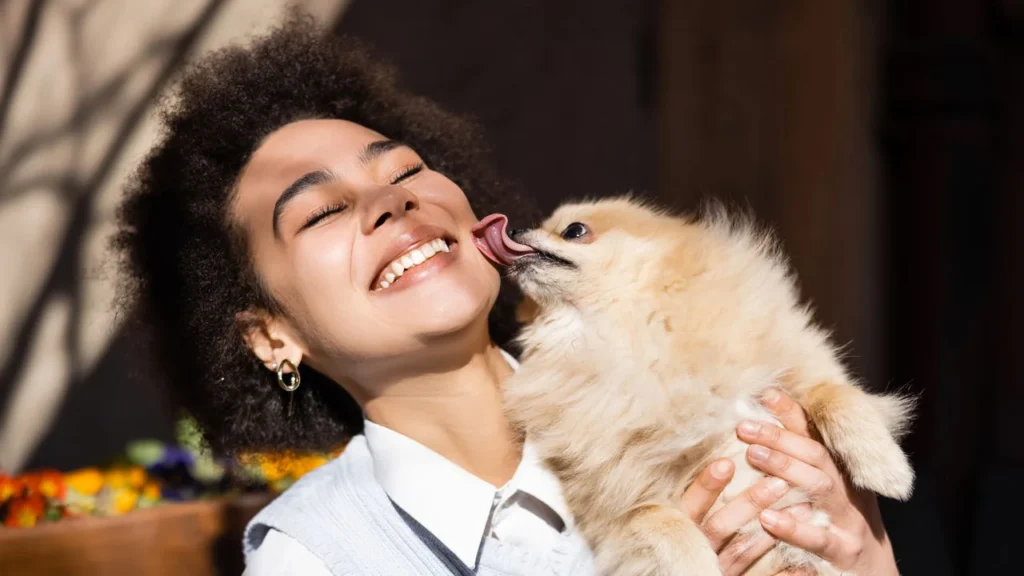
Another very common factor is learning. If every time it licks you, you respond with affection, an excited voice, touch, or attention, it quickly learns that this behavior creates a response.
Over time, it may begin repeating it more frequently.
Conclusion
Your dog licking you so much does not always mean just affection. Very often it involves bonding, sensory reading, attention-seeking, and learned behavior.
Sometimes it is not only showing love.
It is trying to communicate in the way it knows how.