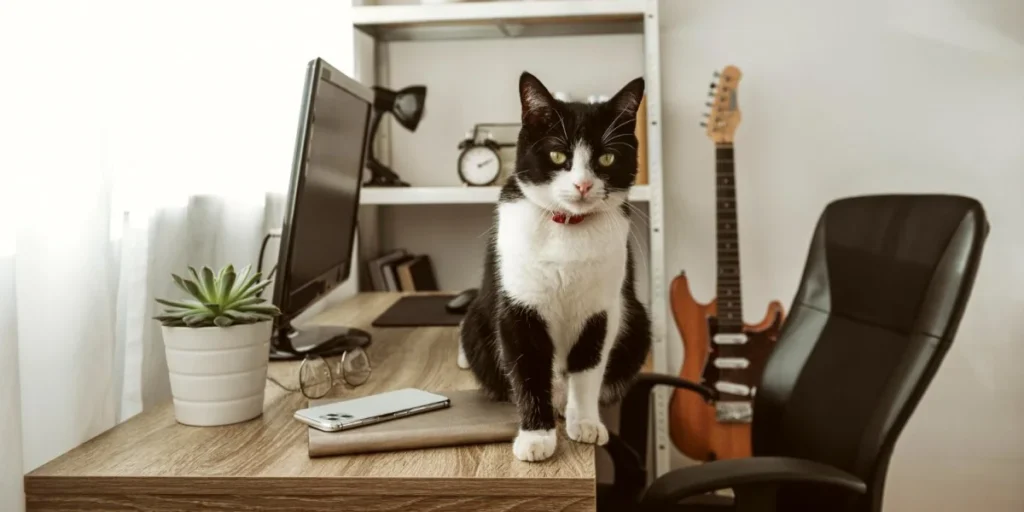
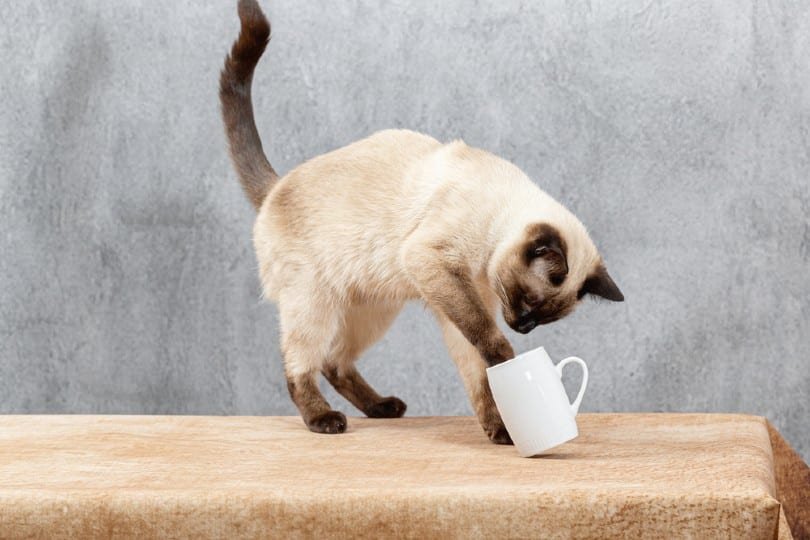
At first glance, few things seem as frustrating for an owner as watching a cat jump onto the table, calmly stare at an object for a few seconds, and then deliberately push it until it crashes onto the floor. It might be a glass, a pen, your keys, a remote control, or any small object left within reach. For many people, this behavior immediately feels personal, almost as if the cat knows exactly that it will be annoying and chooses to do it anyway. That is why many owners quickly label it as stubbornness, attitude, or even provocation. The truth, however, is far more interesting and much less emotional than it seems. In most cases, your cat is not trying to upset you at all. It is simply interacting with the environment in the exact way the feline brain was naturally designed to do.
Cats are incredibly curious, observant, and deeply driven by sensory feedback. Unlike dogs, which often explore space through smell and social cues, cats rely heavily on sight, touch, and movement. When a cat taps an object with its paw and notices that it slides, spins, wobbles, or falls, that action immediately creates a chain of visual, tactile, and sound stimulation. For the feline brain, this is highly rewarding. In other words, knocking something off the table is not random behavior. It creates motion, sound, cause-and-effect feedback, and often mental stimulation.
The most important thing to understand is that, from your cat’s point of view, an object sitting still on a table is not simply a decorative item. It is something that can be tested, explored, and manipulated. Your cat is not thinking in terms of “this belongs here.” Instead, it is responding to instinctive curiosity and environmental interaction.
Cats Explore the World Through Their Paws
One of the most important things to understand is that cats do not rely only on their eyes to explore. Their paws play an enormous role in how they understand the world around them. Very often, even before smelling something, a cat will lightly touch it first to test texture, balance, weight, and movement.
Once the object responds by sliding or tipping, the brain immediately receives rewarding sensory information. The movement itself becomes interesting. The sound of the object hitting the floor adds even more stimulation. This creates a small cycle of curiosity and reward that can encourage the behavior to happen again.
For the cat, this is not destruction.
It is investigation.
That is exactly why the same behavior may repeat itself with completely different objects.
Movement Strongly Activates Hunting Instinct
Another extremely important factor is the hunting instinct. Even inside a comfortable home, the feline brain remains highly sensitive to movement. Small objects that are easy to push can mimic prey-like motion patterns.
A pen rolling across the surface.
Keys sliding.
A bottle cap spinning.
A glass vibrating before it falls.
All of these movements instantly grab the cat’s attention because movement is one of the strongest triggers for predatory focus.
In practice, the object stops being just a household item.
It becomes a moving target.
That is why many cats pause and stare for a few seconds before touching it. They are observing the potential reaction, almost like a hunter calculating the next move.
Human Reaction Often Makes It Even More Interesting
Another detail many owners do not notice is that the human response can quietly reinforce this behavior. The moment the cat knocks something over, people usually react immediately. They speak louder, move quickly, look directly at the cat, or rush toward the fallen object.
From the cat’s perspective, this creates an even bigger chain of stimulation. First the object moved, then the human moved, then the environment changed.
That can make the action even more mentally rewarding.
Sometimes, without realizing it, the owner is teaching that pushing objects leads to exciting reactions in the room.
Conclusion
Your cat knocking things off the table is rarely about stubbornness. In most cases, it is connected to curiosity, environmental testing, sensory feedback, and deeply rooted hunting instincts.
It is not trying to annoy you.
It is trying to interact with the world in the way the feline brain naturally works.
Sometimes what feels like provocation to us is simply instinct, intelligence, and sensory exploration working exactly as nature designed.