
At first glance, it may seem like just a curious habit or a cute behavior, but your dog’s habit of watching you all the time has much more depth than it appears. You are sitting on the couch using your phone, working on your computer, cooking, walking around the house, or even simply standing still, and it is there, in silence, staring at you. Many people interpret this only as affection, attachment, or a desire to stay close, but the truth is that, in most cases, your dog is not just “looking.” It is reading patterns, picking up signals, predicting what may happen next, and absorbing information about the environment through your movements.
Dogs have developed, over thousands of years of living alongside humans, an extremely refined ability to observe. They are specialists in identifying small changes in posture, eye direction, walking rhythm, the objects you pick up, and even the way you move at certain times of the day. For them, every gesture you make can carry meaning. What seems like an automatic movement to you can be a clear signal that something important is about to happen.
The most important thing to understand is that, for your dog, watching you is a constant form of learning, security, and anticipation of the environment. It uses you almost like a living map to interpret the world.
It Is Studying Your Routine More Than You Realize
One of the strongest reasons for this behavior is learning through repeated patterns. Your dog quickly notices that certain movements you make almost always lead to the same result. If you pick up your keys or shoes, that may mean a walk. If you go into the kitchen at a certain time, that may indicate food. If you head to the bedroom at night, that usually means bedtime is coming.
Over time, it begins associating small actions with specific events. That is exactly why, many times, it appears even before you call it. It is not guessing. It has already learned the sequence of your behaviors and can predict what will most likely happen.
In practice, it is constantly studying your routine and turning your movements into predictable signals.
It Uses You as a Reference for Safety
Another extremely important point is the sense of security. Dogs feel much more comfortable when they can predict the environment around them. Watching you helps it understand whether everything is normal, whether something in the space is changing, whether someone has arrived, whether something new is about to happen, or whether it is time to rest.
In many cases, watching you is a way of reducing uncertainty. When it can read your movements, it feels more prepared to respond to the environment.
That is exactly why many dogs stare at their owner even when apparently nothing is happening.
For the dog, something is always happening.
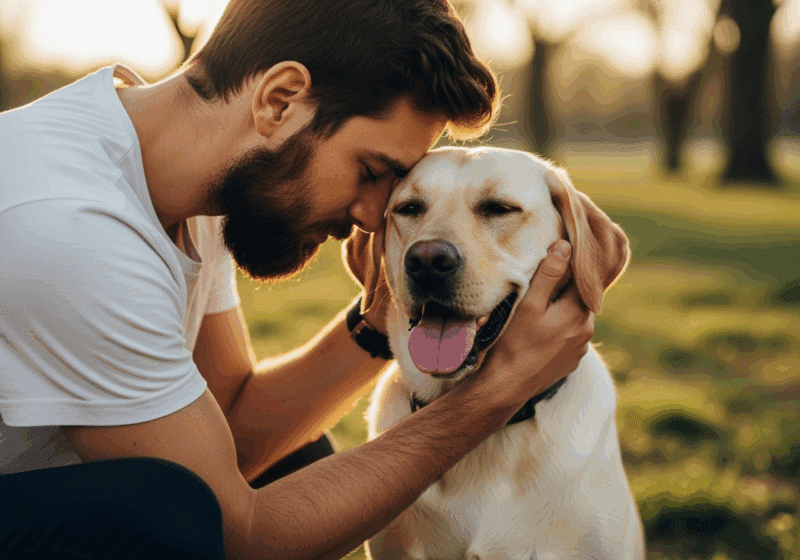
There Is Also a Very Strong Emotional Component
Beyond learning and predictability, there is also an extremely strong emotional factor. You are the main emotional, social, and functional reference point in its world. You represent food, protection, walks, interaction, affection, and stability.
Because of that, it naturally tends to follow your movements with its eyes. In many cases, this is also connected to emotional bonding and the need for closeness.
It is not watching only out of curiosity.
It is watching because you are the center of its environment.
It Learns Things Without You Realizing
This is perhaps one of the most interesting points. Very often, your dog learns your habits and patterns that you do not even consciously notice yourself. Schedules, movement sequences, tone of voice in certain moments, and even subtle mood changes all become part of this process.
That is why many dogs seem to “know” when you are about to leave, when walk time is coming, or when something different is about to happen.
In reality, it has learned signals that you are sending without even noticing.
Conclusion
Your dog watching you all the time goes far beyond affection. In most cases, it is learning patterns, predicting routines, seeking safety, and strengthening emotional bonding.
Sometimes it is not just looking.
It is understanding the world through you and using every movement you make as information to better adapt to its environment.